Watt’s Nearby: giving EV charging a bit more spark
I’ve always liked the idea of taking a simple, everyday problem and building something useful to solve it. With more people switching to electric vehicles, finding a suitable charging point is becoming an increasingly common challenge. So I decided to build Watt’s Nearby — a free UK EV charger finder that does exactly what its name suggests.
And yes, the name is a deliberate little pun.
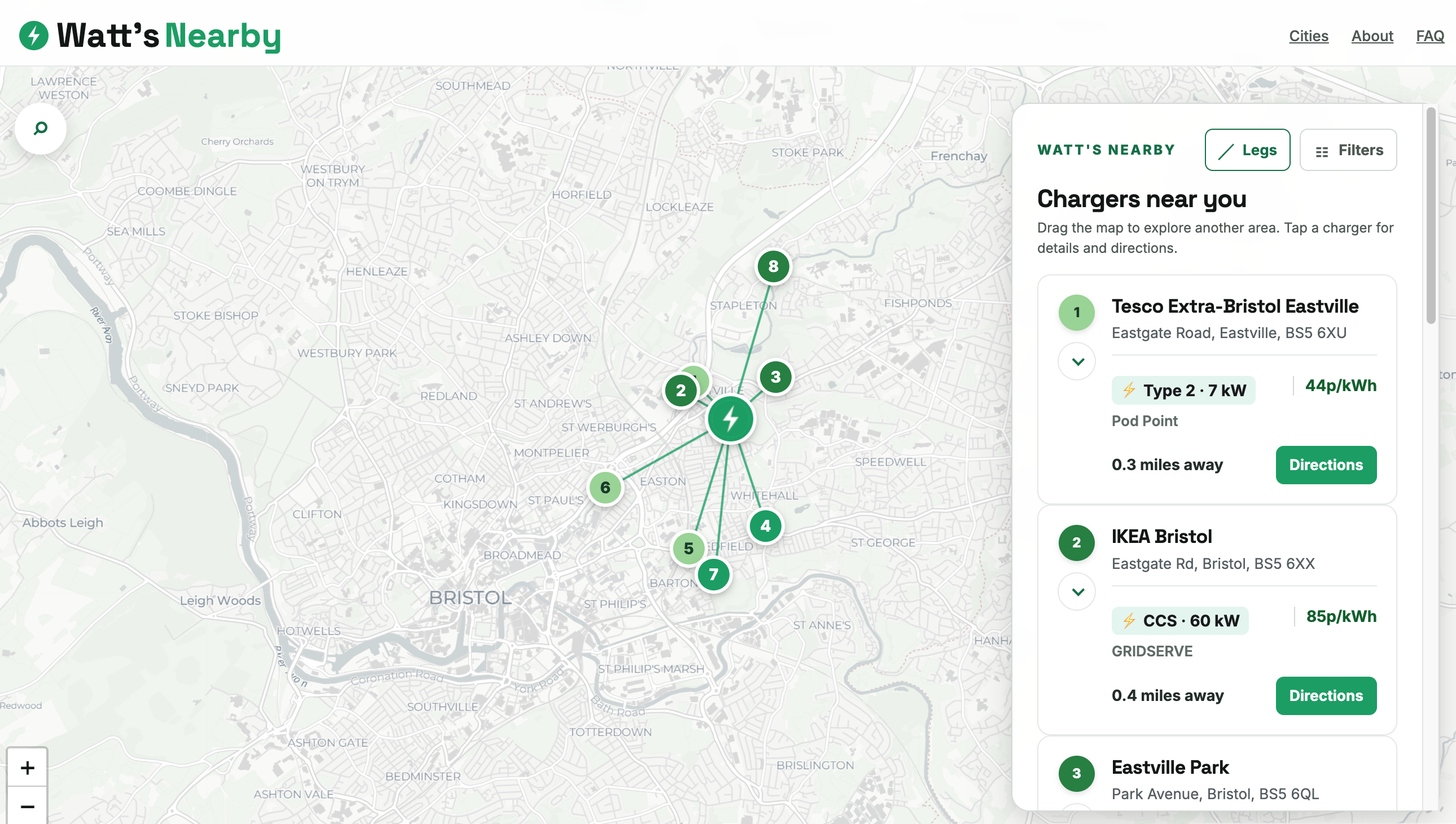
Finding the right map
The first step was finding a mapping solution that was flexible, lightweight and easy to customise. I settled on Leaflet, an open-source JavaScript mapping library, paired with CARTO's clean basemap tiles.
Try Watt’s Nearby →Building the map
The first step was finding a mapping solution that was flexible, lightweight and easy to customise. I settled on Leaflet, an open-source JavaScript mapping library, paired with CARTO's clean basemap tiles. This gave me the foundations for an interactive map without the overhead of building a mapping system from scratch. From there, I could add custom charging-point markers, location search and a results panel designed to work alongside the map.The quest for an API
The more challenging part was finding reliable charging-point data. I explored the Open Charge Map API, which provides information about EV charging locations, connectors and charging facilities. However, no single source covered everything I wanted. I investigated additional sources, including char.gy, to help improve coverage. Bringing the data together meant normalising different responses into a consistent format that the website could display. I built a PHP endpoint to retrieve charger data for a given latitude and longitude, with JavaScript handling the map, markers and results. Postcode searches also needed geocoding to turn a familiar UK postcode into coordinates the map could use.Filters, markers and a little more intelligence
I wanted people to do more than simply look at a map full of pins. Watt’s Nearby includes filters for charging speed and connector type, including CCS, CHAdeMO and Type 2, helping drivers narrow down the options relevant to their vehicle. The site also retrieves stations around the selected location, updates the results as the search area changes and presents the information in a companion list. Behind the scenes, I’ve been refining how data is fetched, filtered and displayed, including how the interface responds when people move around the map. The longer-term idea is to develop the data-gathering process further — effectively a crawler-style approach to bringing together charging locations from multiple sources, rather than depending on a single API to tell the whole story. Data coverage, consistency and freshness are all important considerations.From idea to live website
Turning an idea into a live website involves multiple stages, from initial concept and design to development and deployment. Watt’s Nearby has been a chance to take a project from an initial idea through to a working service, combining interaction design, front-end development, mapping technology and API integration. It’s also a reminder that a seemingly simple interface often depends on a lot of problem-solving behind the scenes. The site is live, and there’s plenty more I’d like to improve as I continue developing it.
Give it a charge: wattsnearby.uk — find EV charging points near you.