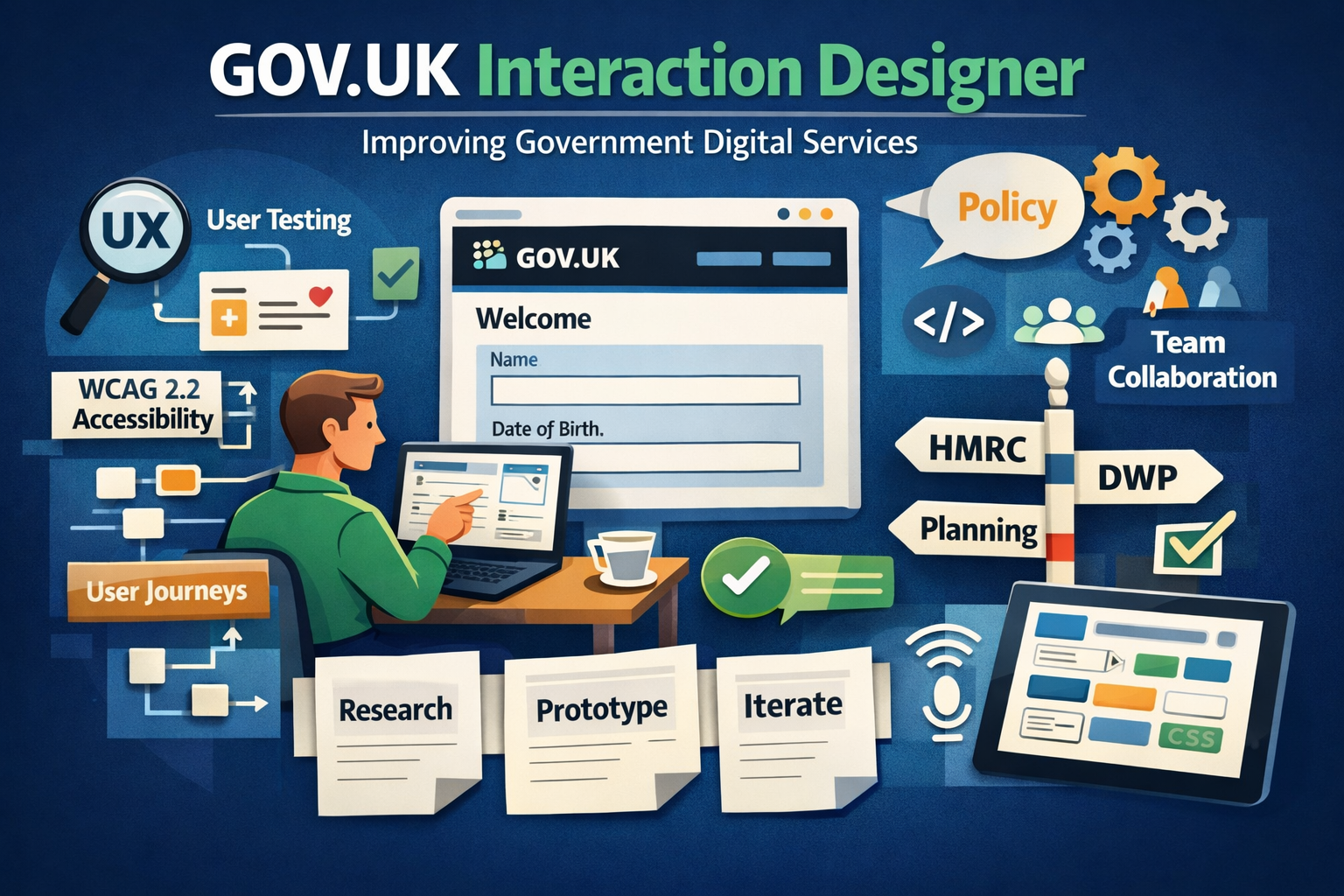
If you have ever used a GOV.UK service and thought “this is simple”, that’s not an accident. It’s the result of deliberate, iterative work by interaction designers, content designers and user reaearchers shaping complex systems into usable journeys.
As a Gov.uk Interaction Designer I’ve worked across departments including HMRC, DWP and the Planning Inspectorate. The role goes far beyond wireframes — it sits at the intersection of user needs, policy, accessibility and delivery.
Designing end-to-end GOV.UK user journeys
At the core of the role is designing clear, usable journeys through complex services.
- Mapping user goals and pain points
- Understanding policy constraints
- Identifying edge cases (which are common in government services)
For example, working on planning and case management services involves designing flows that handle, multiple user types, and complex data inputs. The goal is always the same: reduce cognitive load and help users complete tasks first time.
Working with the GOV.UK design system
A large part of the role is applying and extending the GOV.UK Design System. This means:
- Using established patterns (forms, errors, navigation)
- Avoiding unnecessary reinvention
- Ensuring consistency across services
- Adapting patterns for complex scenario
- Designing new interaction patterns where gaps exist
- Testing whether patterns actually work in context
Prototyping with real interactions
Static designs aren't enough for GOV.UK services. Prototyping is typically done using: HTML, CSS and JavaScript, GOV.UK Prototype Kit using realistic content and data This allows stakeholders to understand flows quickly, dDevelopers to assess feasibility early and end users to test realistic journeys. In practice, prototypes often evolve into near-production experiences, especially for complex services like Case management tools.
The role of a GOV.UK Interaction Designer is about making complex public services usable for everyone. When done well, the outcome is simple, intuitive services that support millions of users.
Explore more in my portfolio section to see how these principles are applied in real projects.
What does a GOV.UK Interaction Designer do?
A GOV.UK Interaction Designer designs user journeys, service flows and interfaces for government digital services, ensuring they are accessible, usable and aligned with the GOV.UK Design System.
What skills are needed for a GOV.UK Interaction Designer contractor?
Key skills include interaction design, accessibility (WCAG), prototyping with HTML/CSS, understanding of the GOV.UK Design System and strong collaboration across multidisciplinary teams.
Is there demand for GOV.UK Interaction Designer contractors?
Yes. UK government departments regularly hire contractors to support digital transformation and service delivery across platforms like HMRC, DWP and other public sector services.